
Spray-Dried Instant Coffee Powder for Your 3-in-1 Premix Formula.
A candidate coffee powder can look right on paper and still behave differently in your premix. PRIMEVN frames each sourcing evaluation around the exact dose, reference grade, technical criteria and commercial terms required by your production line.
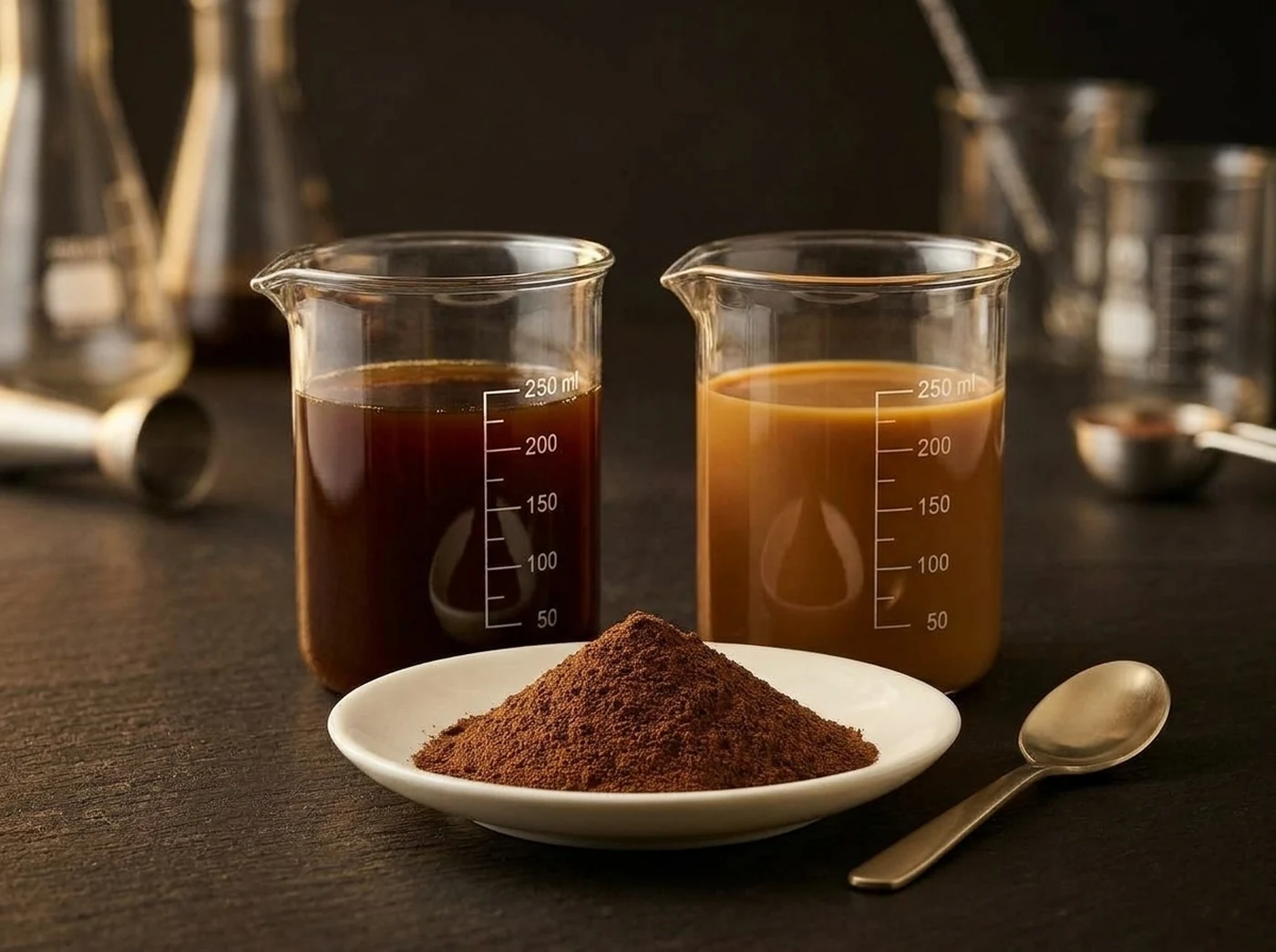
What spray-dried instant coffee powder is
Spray-dried coffee is made by spraying brewed coffee extract into a tower of hot air, which flashes off the water and leaves fine powder particles. It's the base form most buyers mean when they say "instant coffee powder," and the one most commonly used as a raw ingredient inside a finished premix — rather than sold as a finished consumer product on its own.
Choosing Spray-Dried Powder for a 3-in-1 Premix.
In a 3-in-1 sachet, the coffee shares the cup with sugar and non-dairy creamer. A powder that tastes right as black coffee can lose colour, strength or body once the creamer and sugar are in. R&D and purchasing usually need to agree on a few points before a candidate is worth sampling:
- Colour in the finished drink — whether the cup stays as brown as your current product at the same dose.
- Strength through sugar and creamer — whether the coffee still comes through, or you would need a higher dose.
- Dispersion at your preparation conditions — how the powder wets and disperses at your water temperature and volume, without lumps or sediment.
- Dry-blend behaviour — how the powder flows and mixes with the other dry ingredients on your line.
- Cost at the dose you need — compare candidates on cost per sachet at the dose that matches your target cup, not only on price per kilogram.
Bean type, origin and roast profile are confirmed per grade, with documents. To compare a candidate against your current coffee, see how to test samples inside your 3-in-1 formula.
Evaluate the Grade Inside Your Actual Blend.
Compare candidates at the same coffee dose and with the same sugar / creamer / mixing conditions used for your reference. Consider flavour, colour, dispersion, sediment and dry powder behaviour before deciding whether a full line trial is worthwhile. These are evaluation criteria, not performance promises for an unverified PRIMEVN SKU.
What to Include in Your Enquiry.
- Target or control grade
- Coffee dosage and sample protocol
- Sensory targets
- Solubility and bulk density method
- Target volume and packaging
- Destination and required documentation
Once the specification is clear, see how to write an RFQ once the spec is clear.
A Technical Match Is Only the First Check.
A sourcing option must also clear facility identity, grade documentation, sample availability, applicable compliance and workable trade terms. These are reviewed case by case.
Still deciding between spray-dried, agglomerated or freeze-dried? See the buyer's guide to all three formats.
Scope. Format, availability, minimum order and documentation are subject to review for each enquiry. Nothing on this page is a specification sheet or supply commitment.
Limits confirmed via factory TDS. Bulk density test method (free-flow vs. tapped), pH window and moisture ceiling are aligned and confirmed via the grade-specific Factory Technical Data Sheet (TDS) prior to sample dispatch.
Reference standard. Pure soluble coffee produced to TCVN 12459:2018 carries a moisture ceiling of ≤ 5.0% and a caffeine floor of ≥ 2.0% (dry basis, ISO 20481); grade-specific TDS may confirm tighter export moisture limits or high-caffeine 100% Robusta grades (≥ 2.5% to ≥ 3.5%) for 3-in-1 premix formulations.
WhatsApp / Direct: +84 918 874 168 (Hang Pham — Director) — for a quick MOQ or TDS request.